Battery
The battery is the electrical heart of every vehicle. Without a reliable starter battery, the engine remains silent, the on-board electronics go dark and the comfort functions stop working. But modern vehicle batteries are far more than simple lead-acid accumulators – they must supply start-stop systems, withstand extreme temperatures and provide a stable voltage to a growing number of consumers in the on-board electrical system. In this comprehensive guide you will learn everything you need to know about battery types, technical figures such as Ah, V and CCA, correct care and smart purchasing – objectively, fact-based and without advertising promises.
Basics: What does a car battery do?
The classic starter battery provides a high current for a few seconds when starting the engine – typically 200–400 A for a petrol-engined car, and even 500–800 A for a diesel. As soon as the engine is running, the alternator takes over the supply of the on-board electrical system and recharges the battery. When the vehicle is stationary, the battery supplies the quiescent current consumers (alarm system, control units, keyless-go receivers) and buffers voltage peaks. With increasing electrification and hybridisation, the demands rise: start-stop systems require high cycle stability because the engine is restarted many times during a journey. At the same time, new battery technologies such as AGM (Absorbent Glass Mat) and EFB (Enhanced Flooded Battery) must withstand these load changes and are increasingly being fitted in conventional vehicles too in order to increase on-board electrical system stability.
A 12-volt battery internally consists of six cells connected in series, each with a nominal voltage of around 2.1 volts. The actual resting voltage of a fully charged lead-acid battery is 12.7–12.8 V, and for lithium iron phosphate batteries (LiFePO4) around 13.3–13.6 V. For special applications such as classic cars or motorcycles, 6-volt systems also occur. Modern on-board electrical systems work with battery management systems (BMS) that monitor the state of charge, temperature and ageing and regulate the alternator intelligently.
The most important battery types compared
Five technologies have become established for cars, vans and leisure vehicles. Each has specific advantages and disadvantages. The following table summarises the key differences in a compact form.
| Technology | Capacity (Ah) | CCA (A) | Cycle life | Price range | Typical use |
|---|---|---|---|---|---|
| Flooded battery (lead-acid) | 36–100 Ah | 400–600 A | 200–300 cycles at 50 % DoD | 60–100 € | Older cars without start-stop, classic cars with low power demand |
| EFB battery (Enhanced Flooded Battery) | 60–80 Ah | 600–700 A | 300–500 cycles | 90–150 € | Vehicles with entry-level start-stop, high base load |
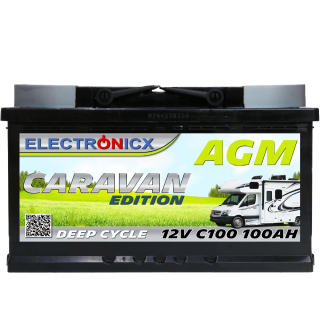
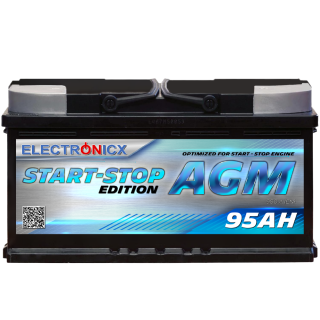
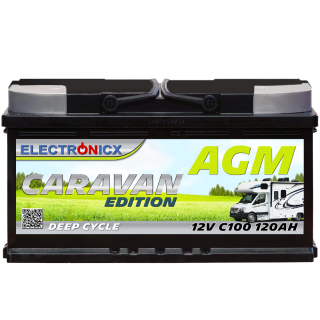
| AGM battery (Absorbent Glass Mat) | 60–105 Ah | 680–800 A | 600–800 cycles | 130–280 € | Premium start-stop, vehicles with brake energy recuperation, camping, car hi-fi |
| Gel battery | 40–120 Ah | 500–650 A | 500–700 cycles | 150–300 € | Motorhomes, marine drives, industry and emergency vehicles with deep discharges |
| Lithium iron phosphate (LiFePO4) | 20–300+ Ah | (not primarily CCA) continuous current up to 100 A and more | 3,000–5,000 cycles at 80 % DoD | 300–1.200 € | Motorhome leisure battery, solar islands, very light vehicles |
What the key figures mean:
- Ah (ampere-hours): nominal capacity at a 20-hour discharge. A 70 Ah model can theoretically deliver 3.5 A over 20 hours. In a vehicle, this figure is an indication of reserve capacity, not of starting power.
- CCA (Cold Cranking Ampere): The standardised cold cranking current at –18 °C that the battery can deliver for 30 seconds without the voltage dropping below 7.2 V. A decisive value for diesel engines and cold winters.
- Cycle life: Number of charge/discharge cycles before the capacity falls to 80 % of the nominal value. LiFePO4 batteries achieve top values here, AGM batteries are superior to conventional flooded batteries by a factor of 4–5.
Buying advice: what to look out for when buying a battery
Not every battery fits every vehicle. In addition to the purely electrical values, the mechanical fit and the terminal arrangement must be right. The most important criteria at a glance:
- Capacity and starting current: The vehicle manufacturer specifies minimum values (e.g. 60 Ah, 540 A CCA). A higher capacity does no harm – it simply provides more reserve and can even extend the service life under part-load operation.
- Size and base strip: Standard sizes such as H5 (length 242 mm), H6 (278 mm) or H7 (315 mm) must fit exactly. The base strip (B13, B14 etc.) determines the mounting.
- Terminal arrangement: Depending on the vehicle, the positive terminal is on the right or left (marked e.g. “1” for terminal on the right, “0” for terminal on the left). Reverse polarity leads to damage to the electronics.
- Technology specification: Vehicles with start-stop and brake energy recuperation almost always require AGM. An EFB is usually the cheaper alternative for simpler systems. Terminal adapters help with differing terminal sizes.
- BEM code: Many new vehicles require the battery change to be coded in the control unit (battery energy management). Without adaptation, the new battery cannot be charged optimally. Specialist workshops take care of this.
As a rule of thumb: do not rely solely on the type number of the old battery, but check using the vehicle documents or the configurator. On electronicx.de you will find the right battery for every vehicle – from small cars to heavy SUVs.
Service life and durability – how long does a battery last?
The statistical service life of a starter battery is between 3 and 7 years – depending on type, driving profile and weather. AGM batteries often reach 6–8 years, while simple flooded batteries in high-mileage drivers under standard load make you think about replacement after 4–5 years. As a leisure battery in a motorhome, LiFePO4 batteries can easily last 10 years and more. Deep discharges, extreme heat and constant short journeys are the biggest enemies: even a single deep discharge below 10.5 V can cause irreversible sulphation in lead-acid technology, which permanently reduces capacity.
The ambient temperature also plays a role: at –20 °C starting ability drops drastically, while permanent engine bay temperatures above 60 °C accelerate ageing. Anyone who looks after their battery, recharges it regularly and protects it from deep discharge can significantly extend its service life. We have put together ten concrete professional tips for this in our detailed guide Extending battery service life.
Charging and maintaining correctly – this is how the battery stays fit
A modern, regulated charger is indispensable today. Unsuitable chargers with constant voltage can overcharge or undercharge AGM and EFB batteries. Depending on the technology and temperature, charging voltages are 14.4 V (flooded), 14.7–15.0 V (AGM) and special regeneration modes up to 16.5 V (lithium). The charging current should not exceed 0.1 C – for a 70 Ah battery, that means a maximum of 7 A in continuous operation. Modern chargers with an IUoU characteristic initially charge at constant current, then at constant voltage and finally switch to trickle charging. Our charger FAQ answers all important questions about charging methods and charger selection.
Battery maintenance work
- Clean the terminals: Remove white or greenish deposits (corrosion) with a terminal brush and protect with terminal grease.
- Electrolyte level: For flooded batteries with cell caps, regularly top up with distilled water – never overfill! AGM and gel are maintenance-free.
- Measure the open-circuit voltage: After at least 6 hours at rest, a fully charged battery should show 12.7 V (flooded/AGM) or 13.3 V (LiFePO4). Below 12.4 V, recharging is advisable.
- Check the mounting: A loose clamp leads to vibrations and accelerates the mechanical ageing of the plates.
Battery disposal – environmental protection and deposit
Old batteries are hazardous waste and do not belong in household waste. The Battery Act Implementation Act (BattDG) obliges retailers to take them back free of charge when you buy a new battery. Municipal recycling centres also accept old starter batteries free of charge. Lead-acid batteries are recycled at over 95 % – the lead, the acid and the plastic casings are returned to the recycling loop. Lithium batteries must be collected separately and recycled in specialised facilities. A deposit of €7.50 on starter batteries ensures that the return system works. When buying, always pay attention to the retailer's return system.
Innovative vehicle batteries and additional systems
The digitalisation of the automobile is also producing intelligent battery sensors. With the battery management system, modern vehicles monitor not only the state of charge but also the quiescent current consumption, the internal resistance development and the starting capability. In future, 48-volt electrical systems and more powerful lithium-ion starter batteries will become established. Another innovation is tyre pressure monitoring systems (TPMS), whose sensors are partly supplied with energy via the vehicle battery. You can find suitable TPMS sensors and accessories in our range.
Ordering and shipping at Electronicx
Have you decided on a new battery? At Electronicx you can order conveniently online and benefit from free DHL shipping within Germany. Your order leaves our warehouse on the same working day and is delivered securely packaged – of course with the legally required deposit certificate and instructions for safe commissioning. Deliveries abroad are possible but are charged with a flat shipping fee.
If you have questions about your vehicle battery, compatibility or technical data, our specialist advisory team at Electronicx GmbH (Hindenburgstr. 37A, 74389 Cleebronn) will be happy to help. You can reach us by phone on +49 7135 7194106 or by email at [email protected].
Frequently asked questions (FAQ) about the battery
Which battery fits my car?
You determine the right battery using the vehicle documents or the type number of the old battery. Pay attention to capacity (Ah), cold cranking current (CCA), size and terminal arrangement. Use the battery finder on our website or contact us – we will determine the suitable model for your vehicle.
What is the difference between AGM and EFB?
EFB batteries are improved flooded batteries with higher cycle resistance (300–500 cycles) and are suitable for simpler start-stop systems. AGM batteries use acid bound in glass fleece, are leak-proof, tolerate deeper discharges and achieve 600–800 cycles – ideal for brake energy recuperation and high electrical loads.
How long does a car battery last?
The service life depends on the driving profile and care. Flooded batteries last 3–5 years, EFB 4–6 years, AGM 5–8 years and lithium iron phosphate 8–15 years. Short journeys, cold and frequent deep discharge significantly shorten the service life.
Can I charge an AGM battery with a normal charger?
Only if the charger has an explicit AGM mode. Conventional chargers with a constant final charging voltage of 14.4 V do not fully charge an AGM and can damage it. IUoU characteristics with 14.7–15.0 V charging voltage are recommended.
What does a battery management system (BMS) do and do I need it?
In lithium batteries, a BMS provides protection against overcharging, deep discharge and excessive currents, and balances the cells. In lead-acid batteries, the vehicle's battery energy management (BEM) regulates the alternator's charging voltage and monitors the state of charge. A separate BMS is only necessary for lithium batteries.
How do I dispose of my old car battery?
Starter batteries are subject to a deposit (7.50 €). You can return them free of charge to any retailer that sells new batteries – or at municipal recycling centres. When transporting them, make sure they are protected against short circuits.
How do I recognise that my battery is weak?
Warning signs are a sluggish engine cranking speed, flickering headlights when starting, the message “Charge battery” on the onboard computer or a resting voltage below 12.4 V after standing for several hours. A load test at a specialist retailer provides certainty.
Why is cold cranking current (CCA) so important?
CCA indicates how much current the battery can deliver at –18 °C for 30 seconds without the voltage dropping below 7.2 V. In winter, the starter motor has to overcome high friction – too low a CCA value means the engine will not start. Diesel vehicles with high compression in particular require high CCA values (often 700–800 A).